

Wipro Limited Misses Revenue Estimates in Q3 2026
Written by Emily J. Thompson, Senior Investment Analyst
Updated: 2 days ago
0mins
Should l Buy WIT?
Source: Yahoo Finance
- Disappointing Earnings: Wipro reported $2.62 billion in revenue for Q3 2026, reflecting a 0.6% year-over-year growth but missing expectations by $7.73 million, indicating pressure in a competitive market.
- Cautious Ratings: Jefferies analyst Akshat Agarwal maintained a Sell rating on February 24 with a price target of INR180, while Geojit Research held a Hold rating with a target of INR227 on February 20, reflecting market caution regarding future performance.
- Contract Value Growth: Despite challenges, Wipro successfully closed $3.3 billion in total contract value and $871 million in large deal bookings during the quarter, showcasing its competitiveness and market demand in large projects.
- Cautious Future Outlook: Management expects Q4 2026 revenue to range between $2.64 billion and $2.69 billion, indicating a growth forecast of 0% to 2% in constant currency terms, reflecting uncertainty in the future market environment.
Trade with 70% Backtested Accuracy
Stop guessing "Should I Buy WIT?" and start using high-conviction signals backed by rigorous historical data.
Sign up today to access powerful investing tools and make smarter, data-driven decisions.
Analyst Views on WIT
About WIT
Wipro Limited is a technology services and consulting company. The Company operates through two segments: Information Technology (IT) Services, and IT Products. IT Services segment provides a range of IT and IT enabled services which include digital strategy advisory, customer centric design, technology consulting, IT consulting, custom application design, re-engineering and maintenance, systems integration, package implementation, cloud and infrastructure services, business process services, cloud, mobility and analytics services, research and development and hardware and software design. The IT Products segment provides a range of third-party IT products, which allows it to offer IT system integration services. These products include computing, platforms and storage, networking solutions, and software products. Its services include Applications, Artificial Intelligence, Business Process, Cloud, Consulting, Data & Analytics, Digital Experiences, Engineering, and Sustainability.
About the author

Emily J. Thompson
Emily J. Thompson, a Chartered Financial Analyst (CFA) with 12 years in investment research, graduated with honors from the Wharton School. Specializing in industrial and technology stocks, she provides in-depth analysis for Intellectia’s earnings and market brief reports.

Wipro Limited Misses Revenue Estimates in Q3 2026

- Disappointing Earnings: Wipro reported $2.62 billion in revenue for Q3 2026, reflecting a 0.6% year-over-year growth but missing expectations by $7.73 million, indicating pressure in a competitive market.
- Cautious Ratings: Jefferies analyst Akshat Agarwal maintained a Sell rating on February 24 with a price target of INR180, while Geojit Research held a Hold rating with a target of INR227 on February 20, reflecting market caution regarding future performance.
- Contract Value Growth: Despite challenges, Wipro successfully closed $3.3 billion in total contract value and $871 million in large deal bookings during the quarter, showcasing its competitiveness and market demand in large projects.
- Cautious Future Outlook: Management expects Q4 2026 revenue to range between $2.64 billion and $2.69 billion, indicating a growth forecast of 0% to 2% in constant currency terms, reflecting uncertainty in the future market environment.
See More

Implications of the 2028 Global Intelligence Crisis on India's IT Sector

- Export Sector Crisis: Citrini Research's report indicates that if AI capabilities continue to improve, India's $200 billion annual IT services export could collapse, directly impacting the country's current account surplus and potentially leading to an 18% depreciation of the rupee within four months.
- Loss of Competitive Advantage: The report emphasizes that the core competitive edge of India's IT services sector lies in low-cost developers, but this advantage will evaporate with advancements in AI technology, forcing companies to reassess the viability of outsourcing models.
- Shift to In-House Development: Following breakthroughs in agentic coding tools in 2025, enterprises can develop mid-market SaaS products internally in weeks, significantly reducing the demand for large offshore IT contracts and impacting future growth in India's IT sector.
- IMF Involvement: As IT exports decline, the International Monetary Fund may initiate preliminary discussions with New Delhi in the first quarter of 2028, indicating increased pressure on the Indian economy and the need for measures to address potential crises.
See More
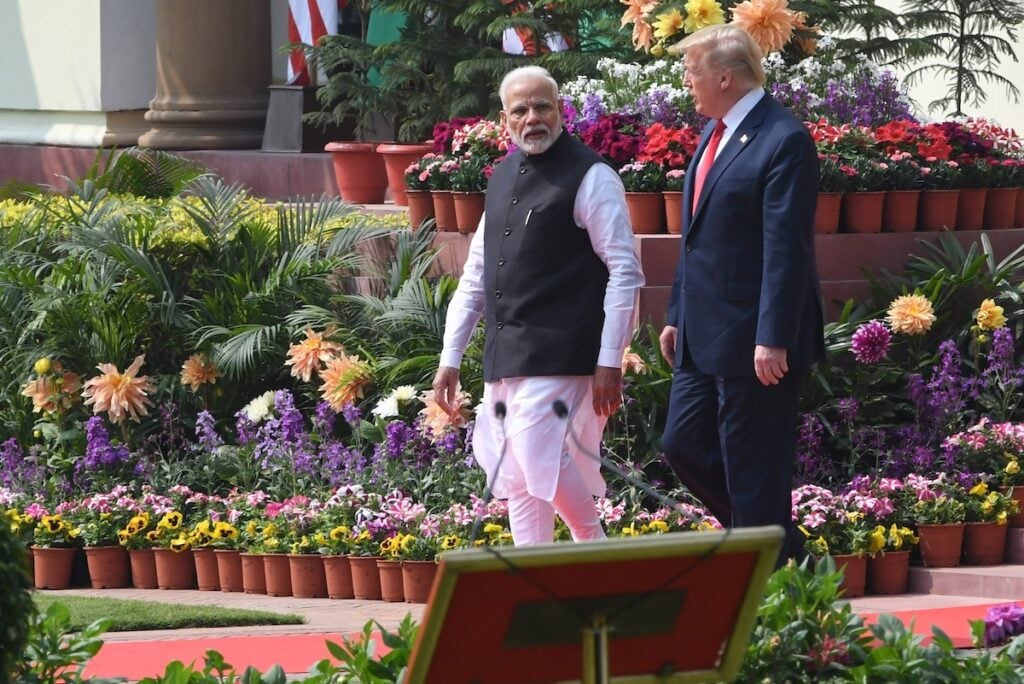
Major U.S.-India Trade Agreement Announced

- Tariff Reductions: Trump announced a U.S.-India trade agreement that eliminates trade barriers for India and reduces U.S. tariffs on Indian goods from 25% to 18%, significantly enhancing trade relations between the two nations.
- Oil Procurement Agreement: The deal ends the 25% punitive tariff imposed due to India's purchases of Russian oil, with Trump stating that India will cease buying Russian oil and increase imports from the U.S. and potentially Venezuela.
- India's Purchasing Commitment: Prime Minister Modi committed to purchasing over $500 billion worth of American products across energy, technology, agriculture, and coal sectors, indicating India's strong interest in U.S. markets and collaboration.
- Improvement in Trade Relations: This agreement is expected to alleviate trade tensions caused by U.S. tariffs of up to 50% on Indian goods, while India is also exploring a free trade deal with the EU to further diversify its international trade relationships.
See More

Wipro's U.S. Shares Rise 6% Following Trump's Announcement of India Trade Agreement
- Market Reaction: Shares of Wipro gained 6% following Donald Trump's announcement regarding a trade deal with India.
- Impact of Announcement: The trade deal is expected to influence market dynamics and investor sentiment towards Wipro and potentially other companies involved in India-U.S. trade relations.
See More

India Announces 20-Year Tax Exemption for Data Centers to Attract Hyperscalers


- Tax Policy Shift: India's Finance Minister announced a 20-year tax exemption for hyperscalers using data centers to service global clients, which is expected to significantly lower operational costs for these companies, thereby attracting more foreign investment and enhancing India's competitiveness in the global cloud computing and AI sectors.
- Market Potential Surge: Experts indicate that with already low data center infrastructure costs in India, the tax holiday will make the country a preferred base for hyperscalers, especially when compared to competing hubs like Singapore, UAE, and Ireland, providing a clear cost advantage.
- Optimistic Investment Outlook: This policy is projected to drive India's data center market capacity to more than double from the current 1.2 gigawatts to over 3 gigawatts within the next five years, meeting the surging demand for AI workloads and attracting significant investments from tech giants including Google, Microsoft, and Amazon.
- Long-Term Economic Impact: The tax holiday will remove the primary friction point for global hyperscalers entering India, expected to substantially increase capital inflows, promote long-term investment returns, and elevate India's position in the global AI race.
See More
Comparison of Vanguard and Schwab Short-Term Treasury ETFs

- Cost and Yield Comparison: Both Vanguard Short-Term Treasury ETF (VGSH) and Schwab Short-Term U.S. Treasury ETF (SCHO) have a 0.03% expense ratio, although SCHO offers a slightly higher yield of 4.06% compared to VGSH's 4.95%, making SCHO more appealing to income-focused investors.
- Assets Under Management: VGSH boasts an assets under management (AUM) of $30.38 billion, significantly larger than SCHO's $12.37 billion, indicating VGSH's greater influence and stability among conservative fixed income investors.
- Risk and Return Analysis: Both ETFs exhibit similar maximum drawdowns, with VGSH at 5.69% and SCHO at 5.71%, demonstrating their comparable risk management, making them suitable for investors seeking low volatility.
- Investor Choice Implications: As interest rate expectations remain unsettled, investors are reassessing low-risk capital allocations, making the choice between these ETFs crucial; VGSH suits those wanting a widely accepted Treasury core, while SCHO caters to those preferring Schwab's framework.
See More
Wipro Limited Misses Revenue Estimates in Q3 2026
- Disappointing Earnings: Wipro reported $2.62 billion in revenue for Q3 2026, reflecting a 0.6% year-over-year growth but missing expectations by $7.73 million, indicating pressure in a competitive market.
- Cautious Ratings: Jefferies analyst Akshat Agarwal maintained a Sell rating on February 24 with a price target of INR180, while Geojit Research held a Hold rating with a target of INR227 on February 20, reflecting market caution regarding future performance.
- Contract Value Growth: Despite challenges, Wipro successfully closed $3.3 billion in total contract value and $871 million in large deal bookings during the quarter, showcasing its competitiveness and market demand in large projects.
- Cautious Future Outlook: Management expects Q4 2026 revenue to range between $2.64 billion and $2.69 billion, indicating a growth forecast of 0% to 2% in constant currency terms, reflecting uncertainty in the future market environment.
See More
Implications of the 2028 Global Intelligence Crisis on India's IT Sector
- Export Sector Crisis: Citrini Research's report indicates that if AI capabilities continue to improve, India's $200 billion annual IT services export could collapse, directly impacting the country's current account surplus and potentially leading to an 18% depreciation of the rupee within four months.
- Loss of Competitive Advantage: The report emphasizes that the core competitive edge of India's IT services sector lies in low-cost developers, but this advantage will evaporate with advancements in AI technology, forcing companies to reassess the viability of outsourcing models.
- Shift to In-House Development: Following breakthroughs in agentic coding tools in 2025, enterprises can develop mid-market SaaS products internally in weeks, significantly reducing the demand for large offshore IT contracts and impacting future growth in India's IT sector.
- IMF Involvement: As IT exports decline, the International Monetary Fund may initiate preliminary discussions with New Delhi in the first quarter of 2028, indicating increased pressure on the Indian economy and the need for measures to address potential crises.
See More
Major U.S.-India Trade Agreement Announced
- Tariff Reductions: Trump announced a U.S.-India trade agreement that eliminates trade barriers for India and reduces U.S. tariffs on Indian goods from 25% to 18%, significantly enhancing trade relations between the two nations.
- Oil Procurement Agreement: The deal ends the 25% punitive tariff imposed due to India's purchases of Russian oil, with Trump stating that India will cease buying Russian oil and increase imports from the U.S. and potentially Venezuela.
- India's Purchasing Commitment: Prime Minister Modi committed to purchasing over $500 billion worth of American products across energy, technology, agriculture, and coal sectors, indicating India's strong interest in U.S. markets and collaboration.
- Improvement in Trade Relations: This agreement is expected to alleviate trade tensions caused by U.S. tariffs of up to 50% on Indian goods, while India is also exploring a free trade deal with the EU to further diversify its international trade relationships.
See More
Wipro's U.S. Shares Rise 6% Following Trump's Announcement of India Trade Agreement
- Market Reaction: Shares of Wipro gained 6% following Donald Trump's announcement regarding a trade deal with India.
- Impact of Announcement: The trade deal is expected to influence market dynamics and investor sentiment towards Wipro and potentially other companies involved in India-U.S. trade relations.
See More
India Announces 20-Year Tax Exemption for Data Centers to Attract Hyperscalers
- Tax Policy Shift: India's Finance Minister announced a 20-year tax exemption for hyperscalers using data centers to service global clients, which is expected to significantly lower operational costs for these companies, thereby attracting more foreign investment and enhancing India's competitiveness in the global cloud computing and AI sectors.
- Market Potential Surge: Experts indicate that with already low data center infrastructure costs in India, the tax holiday will make the country a preferred base for hyperscalers, especially when compared to competing hubs like Singapore, UAE, and Ireland, providing a clear cost advantage.
- Optimistic Investment Outlook: This policy is projected to drive India's data center market capacity to more than double from the current 1.2 gigawatts to over 3 gigawatts within the next five years, meeting the surging demand for AI workloads and attracting significant investments from tech giants including Google, Microsoft, and Amazon.
- Long-Term Economic Impact: The tax holiday will remove the primary friction point for global hyperscalers entering India, expected to substantially increase capital inflows, promote long-term investment returns, and elevate India's position in the global AI race.
See More
Comparison of Vanguard and Schwab Short-Term Treasury ETFs
- Cost and Yield Comparison: Both Vanguard Short-Term Treasury ETF (VGSH) and Schwab Short-Term U.S. Treasury ETF (SCHO) have a 0.03% expense ratio, although SCHO offers a slightly higher yield of 4.06% compared to VGSH's 4.95%, making SCHO more appealing to income-focused investors.
- Assets Under Management: VGSH boasts an assets under management (AUM) of $30.38 billion, significantly larger than SCHO's $12.37 billion, indicating VGSH's greater influence and stability among conservative fixed income investors.
- Risk and Return Analysis: Both ETFs exhibit similar maximum drawdowns, with VGSH at 5.69% and SCHO at 5.71%, demonstrating their comparable risk management, making them suitable for investors seeking low volatility.
- Investor Choice Implications: As interest rate expectations remain unsettled, investors are reassessing low-risk capital allocations, making the choice between these ETFs crucial; VGSH suits those wanting a widely accepted Treasury core, while SCHO caters to those preferring Schwab's framework.
See More




