Lucid Group Faces AI Competition Challenges
Written by Emily J. Thompson, Senior Investment Analyst
Updated: 5 days ago
0mins
Should l Buy LCID?
Source: Fool
- Market Competition Pressure: With a market cap of $3.1 billion, Lucid Group significantly lags behind Tesla's $1 trillion valuation, indicating its insufficient competitiveness in the EV market, particularly in AI technology investment, which poses long-term investment risks.
- Sales Model Transformation: Lucid aims for 20% of its revenue from vehicle sales and 80% from software sales; however, the lack of strong technological appeal makes it difficult to attract other automakers, limiting its market potential.
- Insufficient AI Investment: Compared to Tesla and Rivian, Lucid's limited financial power restricts its ability to invest in AI, and its delay in launching vehicles priced under $50,000 hampers its scalability and data generation capabilities.
- Survival Strategy Challenges: Lucid's survival hinges on supplying its tech stack to automakers without internal systems, but fierce competition from numerous startups makes it challenging, and the absence of a clear path to AI or autonomous driving dominance necessitates cautious investor sentiment regarding its long-term outlook.
Trade with 70% Backtested Accuracy
Stop guessing "Should I Buy LCID?" and start using high-conviction signals backed by rigorous historical data.
Sign up today to access powerful investing tools and make smarter, data-driven decisions.
Analyst Views on LCID
Wall Street analysts forecast LCID stock price to rise
6 Analyst Rating
1 Buy
4 Hold
1 Sell
Hold
Current: 10.000

Low
10.00
Averages
17.00
High
30.00
Current: 10.000
Low
10.00
Averages
17.00
High
30.00
About LCID
Lucid Group, Inc. is a technology company, which designs, engineers, and manufactures electric vehicles (EVs), EV powertrains, and battery systems in-house using its own equipment and factories. It sells vehicles directly to consumers through its retail sales network and through direct online sales. Its vehicles include Lucid Air and Lucid Gravity. Lucid Air is an advanced car, featuring powertrain technology. It offers 420 miles of the United States Environmental Protection Agency (EPA)-estimated range, with an 84-kWh battery pack. The Lucid Air Sapphire is the highest-performance version of the Lucid Air, boasting 1,234 horsepower from three motors, 427 miles of an EPA-estimated range (when equipped with standard wheel covers). The Lucid Gravity provides the interior space and practicality of a full-size SUV within the exterior footprint of a mid-size SUV. It provides space for up to seven adults. It has engineered the Lucid Gravity to deliver up to 450 miles of EPA-estimated range.
About the author

Emily J. Thompson
Emily J. Thompson, a Chartered Financial Analyst (CFA) with 12 years in investment research, graduated with honors from the Wharton School. Specializing in industrial and technology stocks, she provides in-depth analysis for Intellectia’s earnings and market brief reports.
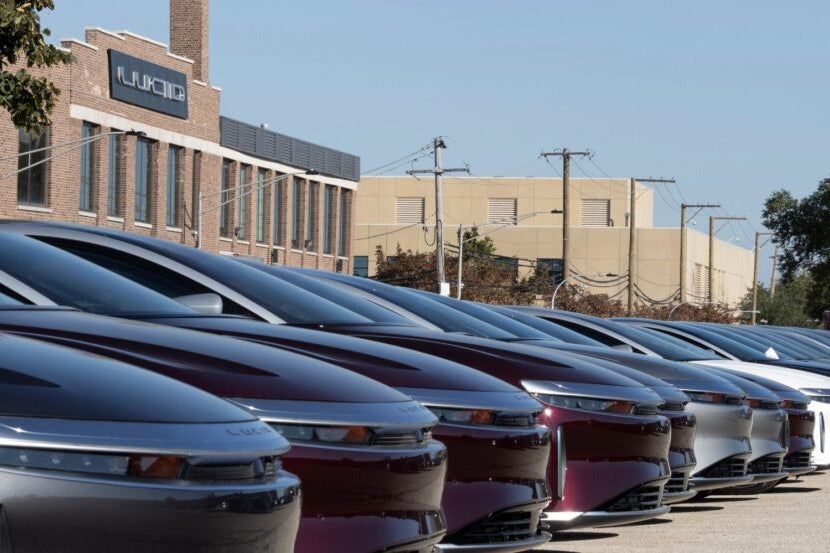
Lucid Faces 2026 Challenges Amid Stock Decline
- Significant Stock Decline: Lucid's stock has fallen approximately 40% since November, primarily due to the departure of executive Eric Bach and concerns regarding the company's future profitability, which has led to a decline in investor confidence and exacerbated the stock's downturn.
- Executive Stock Sales: Eric Bach sold $2.8 million and nearly $1.2 million worth of Lucid stock in the months following his departure, which may reflect a pessimistic outlook on the company's future and raises questions about corporate governance and executive confidence.
- Shareholder Dilution Risk: Since its IPO, Lucid has increased its total shares outstanding by about 90%, while its stock price has plummeted nearly 90%, creating a severe risk of shareholder dilution in future financing efforts, potentially diminishing the value of ordinary shareholders' stakes.
- Bleak Profit Outlook: Despite an expected 80% sales growth in 2026, analysts anticipate significant losses for Lucid, lacking the necessary capital and stock price to support scaling, placing the company at a disadvantage in the highly competitive electric vehicle market.
See More

Lucid Executive's Stock Sales Raise Concerns
- Executive Stock Sales: Former Lucid executive Eric Bach sold $2.8 million and $1.2 million worth of stock in recent months, indicating a diminished interest in ownership after his departure last November, which may impact investor confidence.
- Stock Price Decline: Since Bach's exit in November, Lucid's stock has fallen approximately 40%, closely tied to market concerns regarding the company's future profitability, leading to decreased investor confidence in its shares.
- Shareholder Dilution Risk: Since going public, Lucid has increased its total shares outstanding by about 90%, while its stock price has plummeted nearly 90%, raising the likelihood of continued shareholder dilution to maintain financial stability, putting pressure on ordinary shareholders.
- Increased Competitive Pressure: Compared to Tesla and Rivian, Lucid is lagging in launching mass-market models; despite an expected 80% sales growth in 2026, the company still faces significant losses and lacks sufficient capital to support its expansion plans.
See More

Lucid Group Faces 50% Stock Decline Amid Challenges

- Stock Decline: Lucid Group's share price has dropped approximately 50% since the 1-for-10 reverse split in August 2025, indicating increasing market concerns about its long-term prospects, prompting investors to proceed with caution.
- Financial Losses: Despite significant year-over-year increases in production and revenue in Q4 2025, Lucid fell short of analyst expectations, reporting a loss of $3.08 per share for the quarter and over $12 for the year, highlighting severe financial challenges.
- Market Competition: Lucid aims to produce 27,000 EVs in 2026, but this figure pales in comparison to Tesla's 1.65 million vehicles produced in 2025, underscoring its limited competitiveness in the electric vehicle market.
- Liquidity Risk: While Lucid has $4.6 billion in liquidity, this may not be sufficient to transform the company into a sustainably profitable entity given its ongoing losses, raising concerns about potential bankruptcy risks for investors.
See More
Lucid Group Faces Significant Challenges in EV Market
- Stock Volatility: Shares of Lucid Group (NASDAQ: LCID) are trading just below $10 after a 1-for-10 reverse split in August 2025, with a 50% decline post-split indicating significant market concerns about its long-term viability.
- Financial Losses: While Lucid's production and revenue surged year-over-year in Q4 2025, it still fell short of analyst expectations, reporting a loss of $3.08 per share and over $12 for the year, highlighting ongoing financial strain.
- Market Competition: Lucid aims to produce 27,000 EVs in 2026, but this figure pales in comparison to Tesla's 1.65 million vehicles produced in 2025, underscoring its disadvantage in a fiercely competitive EV market.
- Investment Risks: With $4.6 billion in liquidity, Lucid remains a risky investment, as only the most aggressive investors should consider it; if the company were to face bankruptcy, its stock could potentially drop to zero, posing significant risks.
See More
Lucid Group Shares Drop 50% Post Reverse Split, Raising Concerns

- Stock Decline: Lucid Group's share price has dropped approximately 50% since the 1-for-10 reverse split in August 2025, indicating increasing market concerns about its long-term prospects, prompting investors to exercise caution.
- Financial Losses: Although production and revenue surged year-over-year in Q4 2025, Lucid fell short of analyst expectations, reporting a loss of $3.08 per share for the quarter and over $12 for the year, highlighting its precarious financial situation.
- Market Competition: Lucid aims to produce 27,000 EVs in 2026, but this figure pales in comparison to Tesla's 1.65 million vehicles produced in 2025, underscoring its insufficient competitiveness in the electric vehicle market.
- Liquidity Concerns: Despite having $4.6 billion in liquidity, Lucid's ongoing losses raise doubts about its ability to evolve into a sustainably profitable business, with investors needing to be wary of potential bankruptcy risks.
See More

Rivian Stock Undervalued, Future Growth Potential Ahead


- Significant Valuation Gap: Rivian's price-to-sales ratio stands at just 2.9, starkly lower than Tesla's 15.8 and Lucid's 3.3, indicating that its stock is severely undervalued, although this valuation gap is largely justified by market conditions.
- Technological Investment Outlook: Rivian is actively investing in self-driving technology and artificial intelligence, and while it currently lags behind Tesla and major tech firms in financial capacity, its future technological advancements could enhance its competitive position.
- 2026 Growth Expectations: Rivian is expected to launch its first mass-market vehicle, the R2, in 2026, with analysts projecting a conservative 6% sales growth, which seems understated given Tesla's success with affordable models, suggesting Rivian could experience significant growth.
- Market Potential is Huge: With the R2's release, Rivian is poised to break its current growth stagnation, and the market is optimistic about its future growth potential, especially in the increasingly competitive electric vehicle landscape.
See More
Lucid Faces 2026 Challenges Amid Stock Decline
- Significant Stock Decline: Lucid's stock has fallen approximately 40% since November, primarily due to the departure of executive Eric Bach and concerns regarding the company's future profitability, which has led to a decline in investor confidence and exacerbated the stock's downturn.
- Executive Stock Sales: Eric Bach sold $2.8 million and nearly $1.2 million worth of Lucid stock in the months following his departure, which may reflect a pessimistic outlook on the company's future and raises questions about corporate governance and executive confidence.
- Shareholder Dilution Risk: Since its IPO, Lucid has increased its total shares outstanding by about 90%, while its stock price has plummeted nearly 90%, creating a severe risk of shareholder dilution in future financing efforts, potentially diminishing the value of ordinary shareholders' stakes.
- Bleak Profit Outlook: Despite an expected 80% sales growth in 2026, analysts anticipate significant losses for Lucid, lacking the necessary capital and stock price to support scaling, placing the company at a disadvantage in the highly competitive electric vehicle market.
See More
Lucid Executive's Stock Sales Raise Concerns
- Executive Stock Sales: Former Lucid executive Eric Bach sold $2.8 million and $1.2 million worth of stock in recent months, indicating a diminished interest in ownership after his departure last November, which may impact investor confidence.
- Stock Price Decline: Since Bach's exit in November, Lucid's stock has fallen approximately 40%, closely tied to market concerns regarding the company's future profitability, leading to decreased investor confidence in its shares.
- Shareholder Dilution Risk: Since going public, Lucid has increased its total shares outstanding by about 90%, while its stock price has plummeted nearly 90%, raising the likelihood of continued shareholder dilution to maintain financial stability, putting pressure on ordinary shareholders.
- Increased Competitive Pressure: Compared to Tesla and Rivian, Lucid is lagging in launching mass-market models; despite an expected 80% sales growth in 2026, the company still faces significant losses and lacks sufficient capital to support its expansion plans.
See More
Lucid Group Faces 50% Stock Decline Amid Challenges
- Stock Decline: Lucid Group's share price has dropped approximately 50% since the 1-for-10 reverse split in August 2025, indicating increasing market concerns about its long-term prospects, prompting investors to proceed with caution.
- Financial Losses: Despite significant year-over-year increases in production and revenue in Q4 2025, Lucid fell short of analyst expectations, reporting a loss of $3.08 per share for the quarter and over $12 for the year, highlighting severe financial challenges.
- Market Competition: Lucid aims to produce 27,000 EVs in 2026, but this figure pales in comparison to Tesla's 1.65 million vehicles produced in 2025, underscoring its limited competitiveness in the electric vehicle market.
- Liquidity Risk: While Lucid has $4.6 billion in liquidity, this may not be sufficient to transform the company into a sustainably profitable entity given its ongoing losses, raising concerns about potential bankruptcy risks for investors.
See More
Lucid Group Faces Significant Challenges in EV Market
- Stock Volatility: Shares of Lucid Group (NASDAQ: LCID) are trading just below $10 after a 1-for-10 reverse split in August 2025, with a 50% decline post-split indicating significant market concerns about its long-term viability.
- Financial Losses: While Lucid's production and revenue surged year-over-year in Q4 2025, it still fell short of analyst expectations, reporting a loss of $3.08 per share and over $12 for the year, highlighting ongoing financial strain.
- Market Competition: Lucid aims to produce 27,000 EVs in 2026, but this figure pales in comparison to Tesla's 1.65 million vehicles produced in 2025, underscoring its disadvantage in a fiercely competitive EV market.
- Investment Risks: With $4.6 billion in liquidity, Lucid remains a risky investment, as only the most aggressive investors should consider it; if the company were to face bankruptcy, its stock could potentially drop to zero, posing significant risks.
See More
Lucid Group Shares Drop 50% Post Reverse Split, Raising Concerns
- Stock Decline: Lucid Group's share price has dropped approximately 50% since the 1-for-10 reverse split in August 2025, indicating increasing market concerns about its long-term prospects, prompting investors to exercise caution.
- Financial Losses: Although production and revenue surged year-over-year in Q4 2025, Lucid fell short of analyst expectations, reporting a loss of $3.08 per share for the quarter and over $12 for the year, highlighting its precarious financial situation.
- Market Competition: Lucid aims to produce 27,000 EVs in 2026, but this figure pales in comparison to Tesla's 1.65 million vehicles produced in 2025, underscoring its insufficient competitiveness in the electric vehicle market.
- Liquidity Concerns: Despite having $4.6 billion in liquidity, Lucid's ongoing losses raise doubts about its ability to evolve into a sustainably profitable business, with investors needing to be wary of potential bankruptcy risks.
See More
Rivian Stock Undervalued, Future Growth Potential Ahead
- Significant Valuation Gap: Rivian's price-to-sales ratio stands at just 2.9, starkly lower than Tesla's 15.8 and Lucid's 3.3, indicating that its stock is severely undervalued, although this valuation gap is largely justified by market conditions.
- Technological Investment Outlook: Rivian is actively investing in self-driving technology and artificial intelligence, and while it currently lags behind Tesla and major tech firms in financial capacity, its future technological advancements could enhance its competitive position.
- 2026 Growth Expectations: Rivian is expected to launch its first mass-market vehicle, the R2, in 2026, with analysts projecting a conservative 6% sales growth, which seems understated given Tesla's success with affordable models, suggesting Rivian could experience significant growth.
- Market Potential is Huge: With the R2's release, Rivian is poised to break its current growth stagnation, and the market is optimistic about its future growth potential, especially in the increasingly competitive electric vehicle landscape.
See More